DIY Bluetooth Speaker: Bluetooth 5.0 Receiver, Boost Converter, and a Laser-Cut Cabinet
The goal of this project: turn an off-the-shelf Bluetooth audio receiver board into a complete Bluetooth speaker. Along the way I practiced soldering and wiring electronic modules together, modeled the enclosure in Fusion 360, and exported the panels to a laser cutter to cut the box.

The signal chain
The design is a simple chain of four modules: Bluetooth receiver → amplifier → speakers, with a boost converter stepping a single lithium cell up to the voltage the amplifier needs.
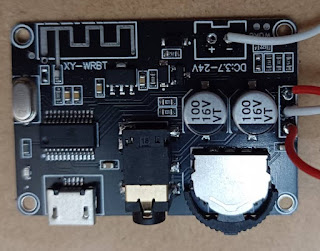
1. Bluetooth 5.0 audio receiver board (with volume control)
A small, inexpensive Bluetooth 5.0 audio receiver with auto-reconnect. It accepts a wide 3.7–24 V supply and has a single rotary button: turn it left or right to change the volume, press it to play or pause. On its own, this module is enough to make any wired speaker wireless.

2. Mini DC-DC boost converter (1.5 A, selectable 5/8/9/12 V)
The amplifier wants 12 V, but a portable speaker runs from a 3.7 V lithium battery. This boost module bridges the gap:
- Output selectable at 5 V / 8 V / 9 V / 12 V (default 12 V)
- Input range 2.5–5 V — a single 3.7 V Li-ion cell fits right in
- Up to about 1.5 A on the input side; the output current is lower, since boosting voltage trades away current

3. Mini stereo amplifier (SFT-9718, 12–15 V DC)
A compact stereo power amplifier board rated for a 12–15 V supply. Its headline "60 W RMS" figure assumes a strong supply; running from a boosted single cell, real output is much lower, but still plenty for a desktop speaker.

4. Speakers and enclosure
The enclosure was modeled in Fusion 360 around the speaker drivers and modules, then exported as flat panels for the laser cutter.


Wiring

Tips if you build one
- Set the boost output before connecting the amplifier. Measure it with a multimeter first; a wrong setting can damage the amp.
- Keep audio wires short and away from the boost converter. Switching converters are noisy, and long input leads near them pick up an audible whine.
- Share one ground between the receiver, amplifier, and converter to avoid hum.
- Add a power switch and fuse on the battery side. Lithium cells can deliver large currents into a short.
This post is adapted from the Traditional Chinese original on Vic's Iteration Notes.
Comments
Post a Comment